
Sophie’s thoughts on editing and people-watching, some with more than 2 legs…
Recently I’ve been obsessed by body language in life and fiction. It all started because the heroine of my current novel is supposed to be good at reading body language and I started to worry about whether she’d over-sold her talents.
But while I was worrying about issues with my lovely Gabriella’s USP, I had a small personal domestic crisis. It took my body–language–reading capacities into the realm of conflict resolution. Urgently.
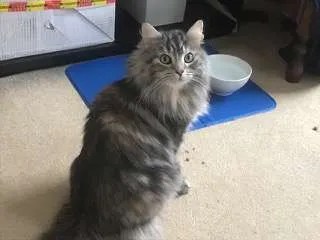
The party of the second part was my beautiful, neurotic but, these days, occasionally, purrful cat, Perdita. And her new catfood.
Cat Issues

I should perhaps explain that Perdita came to me as a very scared and hostile rescue mog. Friends nicknamed her Neurotica. Over three and a half years she has relaxed a lot.
Still bolts for the broom cupboard when the doorbell rings, though. And snarls at her devoted cat sitter when I’m away, too.
She also hates mess. So when she had a tummy upset recently, she did a full spinsterish recoil and was miserable. Sympathetic, I decided to abandon commercial cat food and go for the super nutritious Moggy Michelin-starred stuff, hoping that would prevent a recurrence.

The nice people from Moggy Michelin Central send helpful instructions on how to introduce the new food. Cats, they explain, will sniff food, and walk away to think about it. And then go back and start to scoff.
When we started, Perdita was dining in my study, as she often does. (My choice. I like the company.) As you can see above, she was not immediately impressed. I took it philosophically. After all, I’d been warned and had advice. What’s more, I was editing hard and, after a cordial, “Good Cat,” I went back to my characters.
So she waited a bit. Went back to the bowl. I was immersed in continuity… And suddenly she was back clawing at my thigh. I shrieked (losing a page of carefully ordered conversation) and turned.
Cat Body Language
Perdita has long mastered the Death Stare. I found she was sitting half way between food bowl and door and giving me both barrels. Then she turned her back — on me and the gourmet delight both — and stalked, there is no other word, to the door. And sat.
To be honest, I think she’d already done that at least once. Only I hadn’t noticed.
So she did it again. Louder.

Point taken.
We are currently exploring a compromise.
Body Language— Intentional or Involuntary?

It’s pretty clear to me that Perdita’s body language throughout our association has been intentional. When I tried to lure her out from under the bed to have her first couple of meals, she scratched me to blazes.
Who needs words when you have claws to tell the Enemy to sod off?
Of course, humans have a repertoire of shared physical signals which don’t need a verbal accompaniment. Some of those even get into the language, like thumbs up or the high five.
Shared is the key term here. There are parts of the world where physical signals, second nature to you and me, may mean nothing at all. Or, worryingly, something entirely different — even a threat or insult. Thumbs up, apparently, is the equivalent of the middle finger in Thailand and Iran. Worth knowing, that!

As a child I was told horror stories by a widely-travelled engineer friend of my mother’s about exactly this problem. He’d had to remember to stop himself shaking his head to indicate “No,” to his local workers. To them a vigorous head shake generally meant “Yes, and jump to it!”
“Nearly lost a whole bridge that way, once,” he said with feeling.
But it is the involuntary body language that can be both problematic and fascinating. Especially when an emotion indicated by body movement conflicts with what the person is saying aloud.
Hence the birth of the shifty-eyed villain. And of my current dearly-loved heroine.
Body Language and Me

I first became interested in body language as a teen when a family friend revealed himself as a serious poker player. (He advised me against playing cards for money. Too transparent and altogether too flighty, apparently.)
But he did introduce me to the fascinating idea that people gave away whether they had a good or bad hand by what he called “tells”. And if they were lying, he said, nine times out of ten at some point during the game they would touch their mouth. They just couldn’t help it.

Years later, I came across the same association in The Book of Tells, by Peter Collett. The author had been resident psychologist to the Big Brother programme on television. (I loathed it. The book was a gift.)
It shows a particularly damning photograph of Bill Clinton testifying during his impeachment trial. He has both elbows on the table in front of him and both of his index fingers steepled against his lips, as if he is telling a child to keep a secret.

Collett says of that Clinton photograph that another indicator of lying is “an increased level of gaze.”
That reminded me of a person I once met for work. He was polite, intelligent and very professional. Yet he made my skin feel it was reacting against a nasty irritant. He kept his eyes wide and fixed on my boss or me throughout the conversation. It was very intense, like a child who doesn’t want you to look down and see he’s sneaking the chocolate buttons off the top of the cake. Or a pickpocket, I suppose.
It subsequently emerged that everything he had told us, except for his original aim, was pure fiction. Sobering.
Looking back, I think that incident must have been tickling my subconscious when I discovered that Gabriella was, if not a body language expert, at least an interested and gifted amateur. It is certainly a talent she doesn’t entirely trust.
Interpreting Body Language

I suspect that our interpretation of body language is mostly visceral. Of course, we might read a book or two and rationalise it later. But I think for the interpretation to be any use, both parties have to be in the same place and preferably already know each other.
My father’s poker-playing friend said that you had to know the person fairly well, to pick up significant tells. I interpret that to mean that you need to know the subject’s normal behaviour. Only then can you conclude that a shift or hiccup or eye blink was a reaction to the cards and not just a habitual tic or reaction to one of the other card player’s hair oil.

So is reading body language a Science or an Art? Peter Collett would probably lean heavily towards Science. He quotes Charles Darwin more than anyone else. And wikipedia shows plenty of source papers on the subject. But I don’t see how individual experiments can disprove the underlying theory. So I’d say not Science. But Art? It’s hardly creative. More of a hobby, I’d say.

And when it comes to so-called experts analysing a filmed interview or conversation between celebrities, frame by frame, I am seriously sceptical. Too many variables. Too many unknown unknowns.
But — and here’s the thing that you might find a bit creepy — the person who decided all that wasn’t me. It was Gabriella in a conversation that I didn’t even know she was going to have until it started a few days ago.
Weird old job, this writing lark.
 Sophie
Fascinating stuff, Sophie. Body language is really interesting. I imagine we’ve all come across people we dislike/distrust without knowing why. I can remember the case of a stolen baby where the father was making an impassioned appeal for her return and I knew without a doubt that he’d murdered her. Both parents were arrested and charged days later. And bless your lovely Gabby. It’s such a gift when you know a character so well that she offers you the answer to a question that you hadn’t consciously asked.
How interesting, Liz. I get feelings about people sometimes that I can’t explain. Mostly I’m cautious. (It could just be spur of the moment, personal prejudice, my biorhythms could all be low…)
But a couple of times, I’ve had that absolute certainty that something was badly wrong and I needed to steer clear. I suppose it is a subconscious response to subconscious behaviours. (Wonderful start for a science fiction story, I suspect.)
Oh yes, I’m becoming a great fan of my Gabby. She’s extracted me from a couple of blind alleys so far.
Thank you for making me smile this gloomy Sunday morning. Perdita — I admit to being one of those who called her Neurotica at the start — has definitely got you under her thumb. But then, cats have servants, don’t they? I suspect the “compromise” may be slanted in a feline direction…
I remember when I was a student in Germany, sharing a room with a good mate. We used to play gambling games (not for real money) sometimes and she always knew when I was bluffing. So she always won. She said I had a “tell” but, blast her, she wouldn’t tell me what it was. I still don’t know. Maybe it was mouth-touching? I have no idea.
Glad that Perdita made you smile, baggage that she is.
How galling about your mysterious tell. Of course, SHE could have been bluffing. and it was just blind luck.
Loved this article. Yes cats are supreme at body language, every emotion is shown in a particular movement and THAT stare! how can you ignore it.
Funny how you can tell people’s true feelings by their bodies. I have two granddaughters living in Australia, they message to say they are ok etc but it is only when they face time that I can see how they truly are.
Keep blogging.
Thank you, Yve. The stare works, even when you’re not looking, doesn’t it?
I sometimes wonder if people who are subconsciously uncomfortable, transmit discomfort somehow and then it sort of infects us, too. But, of course, when you know people very well, you know so much — their speech rhythms, the way they carry themselves — and you pick up differences from the norm very quickly, without necessarily knowing that those are the clues!
Perdita is beautiful! And yes, cats are very good at expressing their desires. I find body language stuff fascinating, but I rarely remember to apply it consciously — are their eyes looking up right or what and what does it mean anyway? For me interpretation is all instinctive and several times I have picked up things that later proved to be true.
Great blog. Can’t wait to meet your Gabriella, Jenny.
Thank you, Anne. I can see you picking up the sub-verbal stuff with great clarity.
Hope you will like my Gabriella as much as I’m coming to. Shouldn’t be long now.