
Sophie’s been pondering heroes and why readers do and don’t like them
 As regular readers of this blog will know, I recently started thinking about the hero’s moral compass in romantic fiction. It’s a huge subject, of course, and I feel I’m only scratching the surface so far. But I thought you might be interested in some thoughts that have cropped up along the journey.
I started with Georgette Heyer’s Regency and Georgian novels. I admit this is partly because of the huge popularity of its remote twenty-first century spin-off, the Netflix phenomenon, Bridgerton.
The drama’s colour-blind casting and gorgeous palate of costume and settings has to be a big part of it. But audiences have engaged hugely with the romantic pairings in each episode. The age range of the primarily female audience has been put at 18-64. (Heyer’s own stories are still selling well, at the start of her 2nd century in print.)
 Even if we acknowlege that Bridgerton of Netflix is pretty much fantasy with historical detail for decoration, why?
Is it just because it’s pretty? Because there’s something about a man in a high collar and waistcoat? (When the coats come off, those fabulous shirts with the billowing sleeves are seriously alluring, too.)
Because the actors playing the heroes are generally gorgeous, talented and ride a horse well? Not to mention carrying off a rakish riposte with verve and elan?
Or is there something intrinsic to the behaviour of these Men from the Past that intrigues the modern woman? And not just women, according to Vanity Fair.
Jane Austen and the Hero’s Moral Compass
 Writing in her own time and for her own society, Jane Austen’s hero’s moral compass is implicit. Men effectively have cornered the market in power. They need therefore to take care to behave with fairness to their fellow man and with courteous consideration to women.
Reluctant lover Mr Darcy, having had the rough edges knocked off him a bit by Eliabeth Bennet’s plain speaking, conducts himself as an honourable, generous and discreet gentleman and worthy of the reader’s admiration. (Miss Bennet has learned her lesson too, to be fair.)
Mr Wickham and, even more effectively, Henry Crawford in Mansfield Park, do not.
Both Wickham and Crawford are charming, courteous, listen to the heroine with respect and understanding. They even seem to possess a measure of what today we would call emotional intelligence. But… but…
 They both make bad choices, Wickham several times. They fall away from accepted standards of personal conduct. Their eventual conduct is beyond the pale. One does not have much hope for Wickham and Lydia, who might just squeeze into the society of decent people on the Darcy coat tails.
Wickham is certainly a bit of a professional victim and shares his sob story much too freely. His eventual conduct only just squeezes over the line of acceptable, thanks to Darcy’s intervention. Mrs Bennet may be willing to ignore it. At heart Mr Bennet, and all right thinking people, know the truth.
 The entertaining Henry Crawford is even worse – with the appearance of taste and refinement, he turns out to be a shallow poseur. He seduces and then abandons a married woman. Society turns its back on Mrs Rushworth, but not on him. Her family are devastated.
So we have evidence of what is morally unacceptable, as well as the positive stuff.
I conclude that the Austen hero’s moral compass points to sound judgement, honesty, reliability, restraint, generosity of spirit, and maybe willingness to go out on a limb in support or rescue of the heroine. The hero need not be as rich as Darcy, but he should have the ability to run a respectable career, with the prospect of being a good and considerate provider for a heroine and their future family.
The Hero’s Code in Historical Fiction

Let us rewind to the woman who published her first (18th century-set) novel in 1921 and in 1935 started the Regency Romance ball rolling with Regency Buck. Georgette Heyer was an inveterate researcher in primary sources, not just for historical events but into the minutiae of dress, food, and manners.
She found much of what she wanted in the London Library, especially their fine collection of journals of the period, like La Belle Assemblée and Ackerman’s. She had an extensive library of her own collection and she kept meticulous notebooks of useful details that she came across under headings like Colours, Hats and, sound practical woman that she was, Prices.
 When it came to her Regency heroes, though, Heyer clearly looked for authenticity to Jane Austen first and Beau Brummel second. The moral restraint that Jane Austen looked for is reflected in Heyer’s world-weary dandies’ day to day existence. They are effortlessly supreme in fashion, horsemanship, taste and irony. Oh, and rich.
Lord Worth is all of these, as well as intrusively protective of his reluctant wards. I find him seriously annoying.
By the time we get to The Corinthian (1940), however, über-cool Sir Richard is getting the required kick up the pants from the escaping heiress and becomes a lot less cool by the conclusion of their relationship. The Heyer hero is often in need of a quick course in self-awareness.
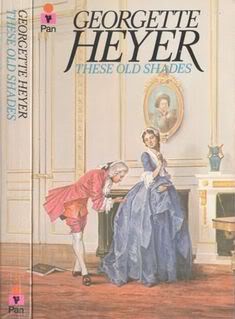 Heyer’s Georgian heroes are equally cool, but rather less well-behaved. The Hero’s Moral Compass comes less from Austen and more from Evelina, Tom Jones and the inimitable Lord Chesterfield.
There is probably a decent thesis to be got out of the influence of Lord Chesterfield’s Letters to his Son on her Georgian-set romances. He even gets a mention in the text of These Old Shades – though it is his prosy conversation, rather than the letters, that give rise to Hugh Davenant’s comment. The letters wouldn’t be published for another twenty-odd years.
Balance of Power and the Hero’s Moral Compass

All the heroes above start off with the unarguable advantage of having legal independence.
Woman generally lives under the control of a husband, brother, son, or guardian. She, quite literally, does not have a vote. If a marriage goes wrong, she can’t sue for divorce. Only her husband can. And any children will belong to him. As will any wealth that she brought to the marriage.
This imbalance of power gives a novelist a fabulous opening. Pitch a story to any editor and the first thing they will ask is where’s the conflict. In most periods of historical romance, this is a no-brainer.

But a hero wants to be fair. That means he needs to bring himself and the object of his affections into some sort of equality if he is to convince her of his sincere regard.
We are talking chivalry.
Some of Georgette Heyer’s predecessors and contemporaries went completely overboard with chivalry to “the weaker sex”. Jeffrey Farnol, Anthony Hope, Ethel M Dell are cases in point. Probably the most lunatic is P C Wren’s adventure story Beau Geste, where three brothers separately pretend to have stolen a necklace that their aunt has actually sold and, to protect her good name, go off and join the French Foreign Legion.

The Heyer hero does not go in for such melodramatics. He does, however, play fair in other ways.
Think Mr Ravenscar, in Faro’s Daughter. Think even the horrible Marquis of Vidal, approaching Mary Challoner, clearly with evil intent, only to find her in the throws of mal de mer. He ends up offering her a basin instead and, appreciating the ridiculous aspect of their situation, laughs ruefully. It almost makes the whole scene bearable.
No gentleman plays with loaded dice. It is not just a question of society’s approval. It is a question of self-respect. I conclude that the romantic hero’s moral compass in historical fiction points squarely at self-respect in his romantic dealings.
BUT what about the Alpha Man?
 The alpha man, the pack leader, the guy Mary Stewart so memorably called “the tiger I thought I preferred”, does what he wants when he wants it. For a couple of generations of romantic fiction there was a vogue for seriously bullying Alphas getting the girl. And I really haven’t sorted that out in my head yet.
I know that many younger readers rebelled against the Alpha hero in the romantic fiction of, say, Barbara Cartland and Violet Winspear among many others. Sometimes, I think, they had a good case, sometimes less so. I need to spend more time reading round the subject.
A Confession
 But here I will just say that I was a member of the team that the Romantic Novelists’ Association fielded on University Challenge, the Professionals, in their fiftieth year. One of the questions I got wrong – you always remember the ones you got wrong – was something about “the most famous romantic hero of all time.”
Of course it’s a pig. My favourite isn’t your favourite, let alone the favourite of the question setter who probably doesn’t read romantic fiction anyway. We all floundered. My mind went a complete blank and I said the first name that came into my head. (I think it was Bertie Wooster!!!)
 The answer, in fact, was Rhett Butler.
Huh? Gun runner and rapist Rhett Butler? Really?
And I still think that. He was a character with no principles at all, let alone a hero’s moral compass.
But thinking about it now, a contradiction occurs to me: my mother and Aunty Mabel would have got Rhett Butler in a heartbeat.
So you see why this remains a work in progress.
 Sophie
I was eagerly awaiting this blog, Sophie, and I must say you did not disappoint. Thank you!
Thank you Sarah. By the tme I started I was feeling a bit overwhelmed by all the hares I’d started running. Sent most of them back to wait their time.
Thought provoking stuff, Sophie. Butler was no hero in my eyes but then Wilkes was if anything worse. Scarlett deserved better from both of them. The first “hero” that leapt to my mind was the young Lochinvar. Sigh. I learned the poem by heart at an impressionable age.
Goodness, I’m impressed. I remember the Lay of Last Minstrel which was supposed to take the Lower Fourth a whole term to read and I polished off in half a wet Saturday afternoon and was bored to sobs. Don’t think it was ideal fodder for eleven year olds.
Young Lochinvar sounds a much better hero than soppy Henry of Cranstoun, at least from what I remember of both of them.
Thoroughly enjoyed this blog.
So pleased, Yve. Thank you.
A fascinating subject. I find it interesting how the moral compass of the hero has changed over time. Georgian literature reveres the hero of highly moral values and respectability (eg Lord Orville), not to mention religious adherence (in the case of Sir Charles Grandison). Since gentlemen of the Georgian era were notoriously badly behaved (by our standards) it’s not surprising the romantic ideal was far different. This seems to have gradually undergone a change through the Regency – as male behaviour equally changed to Victorian moral rectitude – where the bad boy became the hero, a la Heathcliff and his ilk. Come the twentieth century and the cycle appears to have reversed again and travelled via a similar route through the alpha male to the caring and sharing hero we see now. Changing times seem to reflect opposites in life and literature.
You make very good points, Liz. Interesting theory too. I’m adding them all to the list to be considered.
Of course, Sir Charles Grandison was written by Samuel Richardon, the printer who had written Pamela, intending it to be a sort of guide to manners and morals for young girls. It seems that the Grandison story came out of a sort of challenge to write a book precisely in order to show a hero with a strong moral compass.
I seem to remember that the challenge itself came from someone who was outraged by the antics of Fielding’s Tom Jones (a book very dear to my heart, as you may guess from pen name) which in its turn was supposed to be a spoof on the behaviours exhibited by the virtuous Pamela and her fellow characters.
I can see a great deal more research ahead of me on this subject. Ooo, lovely.
Indeed I recall Pamela, and it’s mocking satirical spoof Shamela. I didn’t know Richardson wrote Sir Charles Grandison for a challenge. I found it a fairly dreary plough through. Likewise Clarissa. My favourites were Smollett’s tales. I think I read about three of them
They certainly reflected the bad boy, rough and ready behaviour of his times. Not as much fun as Tom Jones, but gave me a very good insight into the period.
Thought I recognised your pen name, but hadn’t clicked!