Category Archives: self-publishing

Formatting Table of Contents: for independent publishers

woman tearing hairThe Table of Contents (TOC) has led to much hair-tearing by self-published authors, me included. That’s partly because it should be clickable so that the reader can go to, say, Chapter 4, with a single mouse click or touch on the screen.

Why is a clickable TOC necessary?

Because ebooks are not as easy to handle as traditional print books. With print, it’s a doddle to hop back a few chapters or pages to check on something you want to know. With ebooks, not so much. So it’s a very good idea to give readers a table of contents that they can click in order to move between chapters.

Clearly a TOC is essential for non-fiction. Some authors maintain that it’s not necessary for fiction. I disagree. I think all fiction ebooks should include a clickable TOC. And note that Amazon agrees. Amazon KDP have been known to reject an uploaded MS if it doesn’t have a TOC. The KDP instructions say that a clickable TOC should be included.KDP intro to Table of Contents

So this blog is about how you ensure that your MS includes the clickable TOC that Amazon (and readers) want. Continue reading →

Punctuating Dialogue (3) the Full Punctuation Rules?

magic bookIn this third and final part of the blog series on punctuating dialogue, we’re back in the magical, fairytale kingdom of Bel Paese with the unpunctuated Ricotta Dialogues [click to download]. There’s a link to the punctuated version later in this blog.

You can find part 2 of the series here, and part 1 is here. The latest version of The Rules is at the end of part 2 but I’ll be expanding them at the end of this blog, and providing a printable version, so you might prefer to wait for that magic rule book to be opened 😉

But first, last week’s answer?

Continue reading →

Punctuating dialogue (Part 2) Beyond the Basics

Lichtenstein castleLast week I introduced you to the fairytale kingdom of Bel Paese and gave you the first three rules of punctuating dialogue. Today we go beyond the basics.

If you want the recap, it’s at the end of my previous blog here. And you can still download the Ricotta Dialogues here.

This week we’re going to look at slightly more complicated punctuation of dialogue. It’s not used all the time, but it is useful to learn and apply the rules.
As before, they’re simple.

But first, last week’s answers?

Continue reading →

Punctuating dialogue need not be scary (Part 1)

woman tearing hairPunctuating dialogue seems to be a problem for many writers. But it need not be scary. There are conventions (rules) to apply, but once you know them, it’s straightforward. Honest 😉

Beautiful Woman Sitting At Night Forest And Reading Fairy Tale BookCome and discover the rules in the company of Princess Ricotta, her dim but impressively ripped suitors Prince Square-Jaw and Prince Six-Pack, and her conniving servants Slack-Britches and Mozarella. The fairytale kingdom of Bel Paese awaits you.

Those of you who are already confident about punctuating dialogue can read the fairytale just for fun. I hope you enjoy Ricotta’s adventures, even with unpunctuated dialogue. For those whose punctuation might need a bit of help, keep reading.

Punctuating dialogue is only convention

The conventions of punctuating dialogue have evolved over many years. Some of them seem pretty arbitrary but rules often are. We just have to accept them. Their aim is simple, though: to make it easy for readers to understand what’s going on. Continue reading →

Keeping a timeline for your book: why and how

timeline starts with "once upon a time" on typewriterWhat is a timeline? Why should you create one?

Actually, there’s no should about it. You might find it useful. You might not.

I do find it useful while I’m writing, but then I’m a pantser. If you’re a plotter or planner, you might not need it. And even if you’re a pantser, you might find it too much faff.

So, in this blog, I’m going to explain what a timeline is and the benefits I get from using one. Of course, you wouldn’t have to follow my approach. There are all sorts of permutations on a writing timeline. Once you know what’s what, you can make up your own mind, can’t you?

diverging paths, which to choose?

Image by PixxlTeufel from Pixabay

Timeline: an example

A timeline is simply a way of recording what’s happening in your book as you create it: plot, characters, timing, motivations, emotions. The lot. There are all sorts of ways of doing a timeline for your book. Continue reading →

Finding appropriate images to use legally and fairly

glorious beach, north-west Scotland © Joanna Maitland

glorious beach, north-west Scotland © Joanna Maitland

How often, when you’re writing a blog or preparing something for social media, do you tell yourself you need to include an image? Most of the time, I’d guess. But finding appropriate images can be difficult.
Certainly time-consuming.

And even when you’ve found one, can you legally use it?

This one on the right, of a glorious beach in north-west Scotland, is fine because I took it myself. My copyright. No problem.

That’s my first tip.
Tip #1 Use your own pics whenever you can.
And if you’re worried about other people snaffling them, make sure you mark them as your copyright. (I don’t do that, normally, but in this instance, I have. Note to self: I probably should claim copyright routinely though I’m already partly covered by Tip #2 below.) Continue reading →

Writing your Manuscript using Word Styles: The Easy Way

oops! on key on keyboardWe’ve just passed the submission deadline for the RNA’s New Writers’ Scheme. And I’ve heard whispers from some readers that the MSS they are being sent to read are not as professionally prepared as they should be. That’s sad. And unnecessary, too.
Professional layout isn’t difficult. Especially with Word Styles.

Some aspiring writers, I’m sure, tell themselves that the most important thing is to get their pearls onto the page. They can sort out the niceties of formatting later. But that’s a waste of effort. It means doing stuff twice when it could be done once, Right First Time. So this blog is about how to set yourself up to get your MS Right First Time, while you’re actually creating it.

This blog is long—sorry—because I’m trying to explain every step of what you need to do. But it won’t take long to do it, and you only have to set up these Word styles once, so it’s no great chore. In fact, it’s an investment. Once you’ve created them, you can keep using them in every story you write.

Easy write, right? 😉Hello I'm a Time Saver badge

What does a writer need by way of Word Styles?

Continue reading →

Book descriptors : but what do they actually mean?

TBR pile of booksThis week, in connection with something unrelated to this blog, I came across a lot of book descriptors. By that, I mean the kind of words that are supposed to identify types and genres of fiction. Now I think I know what’s meant by romance or historical or saga. But some of the others? Um. Not so much.

So this blog is about a failing in my education. I need to get my head around these new and unfamiliar words to describe fiction. Who knows, I may even be writing some of them?
But if I don’t understand the book descriptors, how will I ever know?

Uplit, or Up-Lit, or Up Lit (Take your pick on spelling)

One of the first book descriptors I fell over was Uplit. I tried the dictionary. Nope. (It asked me if I’d meant to type uplift. Sigh.) Continue reading →

Series Covers : but what says Series Covers to readers?

Earlier this week, our own Liz Fielding published a blog about her series covers over 30 years of her writing career. It was fascinating. And it made me think about brands and series.

What makes Series Covers?

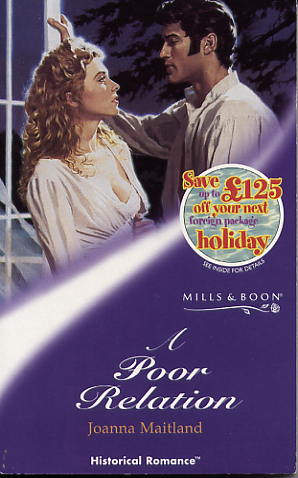
A Poor Relation by Joanna Maitland coverCover of A Baby Of Her Own by Kate HardyHarlequin Mills & Boon have been producing different series for decades. Readers may be fans of one or more of these series. Perhaps they love Medicals (left), or Historicals (right).

Readers expect to be able to identify their particular series covers the moment they look at the shelves in the bookshop. It used to be easy because of the colour coding: for example, Medicals were the jade green shown above; Historicals were Dairy Milk Purple. Modern and Romance (of which more below) also had the swoosh against blue (for Modern) and orange (for Romance).

And within their favourite series, readers want to be able to pick out the authors whose books they love. Preferably without having to peer at tiny or barely legible print. The two cover images above don’t get very high marks on that front. It would have been easy to remedy, though.

To give the paying customers what they want.
Simples, no? Isn’t that what branding is about? Well… Continue reading →

Covers: should images be historically accurate?

Historically accurate costumes?

Is it historically accurate to wear a tablecloth over a Regency gown?Those who follow this blog will know that I often bang on about cover failings. I want my covers to be historically accurate. For me that means: no Regency heroes with beards or designer stubble; no twirling round the dance floor wearing knee-high boots; ladies in Regency costume that isn’t swathed in a tablecloth (see left); and hairstyles and accessories appropriate for the period.

It also helps if the cover models look vaguely like the characters in my story, but that’s a rant for another day 😉

Historically accurate backgrounds?

Life Guards on horseback with Wellington Arch in background, not historically accurate for 1814I’ve recently been mocking up a cover for a book I’m writing. It’s set in London in the period between Napoleon’s exile to Elba in 1814 and his return the following spring. My hero is a serving soldier who’s enjoying his first leave for 5 years.

I thought it could be good to show uniformed soldiers in the background on my cover. I found the image shown right.

Great image for a Regency cover, yes? Continue reading →