
Guest blog from Marilyn Pemberton, introduced by Joanna
 Our guest this week is Marilyn Pemberton, who is passionate (and fascinating) on the subject of fairy tales. Her writing career began with the biography of the Victorian fairy-tale writer, Mary de Morgan, Out of the Shadows. She then moved into fiction where her first book was a fictionalised version of Mary de Morgan’s life, The Jewel Garden.
Later she wrote a series of stories in which fairy tales play a huge part. It starts with A Teller of Tales (set in 1820s). Then comes A Keeper of Tales (1880s), followed by A Seeker of Tales (1900s) and A Bearer of Tales (1910s). The final book of the series, A Maker of Tales, is scheduled for publication in 2026.
Marilyn has also written poetry and two books that have nothing to do with fairy tales. Sold for a Song is a tale of two castrati set in eighteenth-century Italy, and Under the Eye is a 1930s adventure set in Egypt. So you can see that Marilyn’s writing ranges widely. And it’s quite a change for someone who used to be an IT project manager 😉
For today’s blog, she is going to return to her first love, fairy tales. Over to Marilyn:
Telling and retelling of fairy tales
Stories have been told since time immemorial. They have been categorised as myths that honour immortal protagonists and cosmological events, legends that relate to extraordinary protagonists and extraordinary events, folk tales that tell of ordinary, often simple folk…
And fairy tales.

What is a fairy tale? There are as many definitions as there are academics trying to define it. But the general consensus is, as Steven Swann Jones suggests, that fairy tales are “dominated by fantasy, they involve significant interaction with the magical and the marvellous.”

Fairy tales do not have to include tiny people with gossamer wings. Nor do they have to start with “Once upon a time” and finish with “and they all lived happily ever after.” They are not necessarily for children, either. People told fairy tales many centuries before the concept of childhood in the 18th century.
Fairy tales from all around the world are similar, we know, because they tell of universal fears, such as starvation, oppression or persecution. They also tell of hopes of a better life. Have you noticed how the characters in these tales have generic names, such as the King, the Princess, the Belle or the stepmother? They are not named; they are not specific people. They are no-one. And they are everyman.
Fairy Tales can have many incarnations. Try Red Riding Hood?
 See! Sweet and sound she sleeps in granny’s bed, between the paws of the tender wolf.
I am certain that you will all recognise which fairy tale Angela Carter is retelling in this quotation from The Company of Wolves (in her collection The Bloody Chamber, 1979). However, it is very different from the story of Little Red Riding Hood that we all know. It is from a feminist perspective with the female ultimately taming the wolf.
Would it surprise you to know that the fairy tale you all probably know as told by the Grimm Brothers (Kinder- und Hausmärchen, 1812) is also a retelling of one told by Charles Perrault, which is also, in turn, a retelling?
The original story of the wolf, the granny and the little girl is thought to be an oral tale told in France in the Middle Ages.
Medieval version

The Story of Grandmother, as it is known, has all the ingredients that we are familiar with:
- a werewolf (not a wolf) who meets a little girl at the crossroads
- a granny eaten by the werewolf (and her flesh and blood is stored in a cupboard to be eaten later by the granddaughter)
- the granddaughter (with no mention of a red hood or bonnet) who visits and is lured into bed (naked, as ‘Granny’ tells her to put her clothes on the fire)
- the well-known dialogue about size of ears and teeth.
But this girl is not a victim. She realises her life is in danger and outwits the werewolf and manages to escape.
This tale is earthy and tells of contemporary fears — hunger, superstition and attacks by animals. It celebrates a young girl saving herself and overcoming threats and obstacles.
Seventeenth century version

Skip quite a few centuries to Charles Perrault (1628-1703), who wrote his Histoires ou contes du temps passé, avec des moralités: Contes de ma mere l’Oye in1697 for an educated, upper-class audience.
One of these stories was Little Red Riding Hood.
It is Perrault who introduced the red hood. In his tale it’s a wolf not a werewolf that meets the girl in a wood. (By now, a wood in literature is a place of fear and magic.) He still kills granny but he eats her whole. There is no mention of keeping the flesh and blood.
The girl still gets into bed but remains fully clothed.
There is then the same dialogue with the result that the wolf gobbles her up.
The End.

Both Granny and the girl stay dead. They cannot save themselves and no one else saves them. Perrault ends his tale with a moral which warns young ladies of the dangers of being seduced by a young wolf.
Perrault has rewritten the tale with a very different motivation from the earlier story. His aim is to set standards and models of refined virtuous behaviour for the young ladies of his time. He has effectively civilised the oral folk tale into a refined literary tale for the upper class.
The Brothers Grimm and Red Riding Hood

Skip another 120 years or so to 1812 and the Grimms Brothers’ Rotkäppchen. It’s based on Perrault’s version but even more sanitised because this story is for children.
The start of the story is the same. The wolf still eats granny and gets into her bed but there is no mention of the wolf asking the girl to join him.
There is the same dialogue. The wolf eats the girl and falls asleep.
A hunter hears the snores, slits open the wolf’s belly and hey presto, out leap both the granny and Little Red Cap totally unscathed!
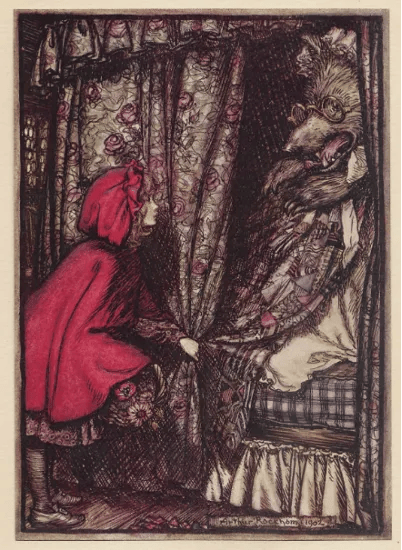
Is this the version you all know? (There’s an illustration here from an early 20th century Grimms’ Fairy Tales.)
The story ends with Little Red Cap saying to herself: “Never again in your life will you stray by yourself into the woods when your mother has forbidden it.”
The girl has become more and more helpless and naive. She needs guidance and saving—
by a male.
The Brothers Grimm changed the story to satisfy the morals and ethics of the emerging bourgeoisie in the 19th century. They were also endorsing the ideology of patriarchy.
How many versions?
 In The Trials and Tribulations of Little Red Riding Hood, edited by Jack Zipes, there are 31 versions of Little Red Riding Hood, up to 1982. There are eco-friendly, politically correct and feminist versions.
All have their own agenda but all use the basic story elements that we recognise.
One of my favourites is by Roald Dahl in 1982, which includes the fabulous lines:
 The small girl smiles. One eyelid flickers.
She whips a pistol from her knickers.
She aims it at the creature’s head,
And bang bang bang, she shoots him dead.
Animation began early

Walt Disney, too, was renowned for retelling fairy tales. He used Little Red Riding Hood very early in his career (1922).
His agenda was to promote the American dream by idealising the American family unit and offering America as the land of opportunity. In Disney’s America, the most ineffectual and marginalised can become the greatest and most powerful.
A fairy-tale ending indeed.
Fascinating layers, aren’t they?
Joanna again. I find these layers of change and meaning fascinating. And I didn’t know about the various incarnations of Red Riding Hood, though I did know about very nasty predecessors of the usual Cinderella story.
Marilyn’s books are available from Amazon in print and as ebooks. Here’s the blurb for the first of her Tales series:
 Lizzie lives with her family in the mining town of Wednesbury, Staffordshire.
Frustrated by the constraints put on females in the 1820s, she tells Bobbit, her damaged, younger brother, tales of independent, brave and feisty girls; girls who go on quests to put right wrongs; girls who use their prize money to set up all-female schools; girls who spurn the Prince’s offer of marriage because she doesn’t love him; girls who teach young princesses, not the traditional subjects of dance, art and music, but where the stars go during the daytime, where worms live and how to listen to the stories the rivers tell.
Only when Bobbit takes one of her stories literally, with disastrous results, does Lizzie realise that her brother really does understand more than she, or anyone, ever thought.
Real life, however, isn’t a fairy tale and any bid Lizzie makes for adventure or independence is thwarted because she is a female; even her fairy tales are rejected for publication as not being ‘suitable.’
Lizzie has to make a decision. Is the chance of the life she has always dreamed of worth the price she will have to pay? Will it give her a happy ever after?
Many thanks to Marilyn for sharing her knowledge with us
We hope you enjoyed this little diversion into a different kind of fairyland. But there’s much more to find out from Marilyn. You can learn more from her website and on her blog. You can also find her on Facebook as Marilyn.pemberton.39. Enjoy!

The evolution of fairy tales is a fascinating subject, Marilyn and revealing about the times in which they were told. I have the Angela Carter but I’d missed the Disney adaptation! I love the sound of your latest book and looking forward to reading it.
Thank you Liz. I wrote my own fairy tales for A Teller of Tales – it was great fun! I hope you agree that they reflect Lizzie’s frustrations and hopes.
Oh this is wonderful.
I loved reading folk stories when I was a child – there was a whole series from different countries in our local library and I took them out so many times, the Librarian suggested that I might like to buy their copy of the Japanese one. Nobody else had ever borrowed it! But my favourite was the fairy story, starting with Andrew Lang’s Violet Fairy Book and other colours.
And I’ve continued with contemporary tellers of magic and marvels, especially Robin Mackinley (who had at least two goes at Beauty and the Beast and, in “Sunshine”, a truly frightening but redemptive vampire story) and Diana Wynne Jones. Am now adding Marilyn’s novels to my TBR list en masse.
THANK you.
I’m sure you know what a great feeling it is to receive such a lovely comment. Thank you! I am actually working on my 5th book of the series (A Maker of Tales) and you have given me a real boost.
What a fascinating post, Marilyn – I grew up on fairy tales and have read lots of variations of them ever since. Many of my own romances are loosely based on Cinderella, Sleeping Beauty, Rapunzel etc. etc. because fairy tales tap into something deep inside us. Thank you for such a fascinating, informative post.
Thank you for such a lovely, supportive comment.