
Recently I tootled south to Dundee for a rather special event. A talk and demonstration of how to dance, 18th century style!

No. Not quite like that! Dance like this…..

Although this Dundee lecture and recital focused mainly on 18th century Scotland, much of it applied to the fashionable society in England, too. And it was fascinating!
The dance venue:
This dance event took place at the Wighton Centre in Dundee Central Library, which just happens to have its own harpsichord. Not many libraries can say that. Mark Stevenson built this one in 1983, in the style of the 18th century maker Nicholas Blanchet.

The first thing one notices is that the key colours are the opposite way around to the modern piano. This was usual for earlier keyboard instruments like clavichords, harpsichords and fortepianos. Ivory being more expensive than wood, it made sense to use it for the smaller keys.

Also, apparently, the black keys are a flattering backdrop for a lady’s dainty hands.
Yep, probably more flattering than a computer keyboard.
The particular model in Dundee Library is a double-manual instrument, with two keyboards and two sets of strings. With the top keyboard pushed in, the keys pluck only one string, but when it is pulled out, it brings into play the second set of strings, so each key plucks two strings instead of one, giving more volume.
Harpsichord = romance. Really?
Most of the harpsichord music I have heard has been in costume dramas, as accompaniment to dance scenes, and it has always sounded a bit, well, unexciting.

Prim and proper.
Starched up.
Hardly the sort of instrument to induce the feeling of heart-stopping romance that I want to evoke in my books. However, this Dundee recital proved that the harpsichord could be fast and exciting as well as reflective and tender. It was the perfect backdrop for some of those all-important dancing—or flirting—scenes.
Our Harpsichordist
Frances Scott trained at the Royal North College of music and has worked for Scottish Ballet and the Royal Ballet Company. She made the instrument come alive. Frances has a deep interest in music and dance in 18th century Scotland and performs with the Bruntsfield Baroque Trio.
The three pieces she played for us, including one called Dunira Lodge by Magdelene Stirling of Ardoch*, were all lively and full of energy!

*If you want to hear one of Magdelene’s compositions, The Earl of Elgin’s Strathspey, it is played on guitar and fiddle here
Female Composers of dance

Frances explained that although it was not unusual for 18th century ladies to write lyrics, not so many of them wrote music and those who did preferred to publish their work anonymously.
Some ladies, however (such as Magdalene Stirling mentioned above) were quite happy to add their names to their work.

Men such as Nathaniel Gow (1763–1831), a successful bandleader and publisher, gathered together and published books of dances. If a dance was described as “by a lady”, it was understood that an anonymous lady had written the music herself. Sometimes it was described as “communicated by a lady”—which meant that Gow had written the music down for them.
Paintings of these early female dance composers are hard to find, but I did find Anastasia Robinson (1692-1755), pictured opposite. She is now billed in the Encyclopaedia Britannica as “an English pop singer & songwriter”, so no dances, but you get the idea!
Our harpsichordist, Frances, played three pieces for us, the perfect warm-up before she accompanied Alena’s dance demonstrations.
Our Lecturer on dance

Dr Alena Shmakova is a dance historian based in Edinburgh.
She teaches and performs historical dances from 17th-19th century and is part of a historical dance group—Les Danses Antiques.
Although the talk was primarily about 18th century dance in Scotland, many of the dances performed at the early assemblies were also popular in England.
As you can see, for this performance Alena dressed up to dance for us!
Scottish Assemblies
At the beginning of the 18th century in Scotland, it was the ladies who organised and ran the dances, or assemblies, many of them held for charitable causes.
After the Jacobite Rising in 1745, however, committees took over the finances of this popular form of entertainment (committees of men, that is!) while the ladies were left to organise and host the dances. And given the title of Directress, for their trouble.
The first purpose-built Assembly rooms appeared in Edinburgh in the 1780’s, while Dundee’s primary Assembly Rooms, The Thistle Hall, was built in 1824. It was quickly followed by the one below, the City Assembly Rooms, built in 1828 to a design by George Smith.

Not everyone was in favour of this form of entertainment. Religious groups complained that “Devils are particularly busy at assemblies.” In the prosperous fishing and whaling village of Broughty Ferry, some church-going residents warned that the dancing in Dundee was “frightening the fish”!

Dance demonstrations
 Alena described the various dances and even demonstrated some of them, using her interpretation of contemporary dance instruction manuals.


Alena kindly allowed me to photograph her performing the minuet, seen here and in the earlier photo, above.
She also performed the faster Mrs Parker’s Reel.
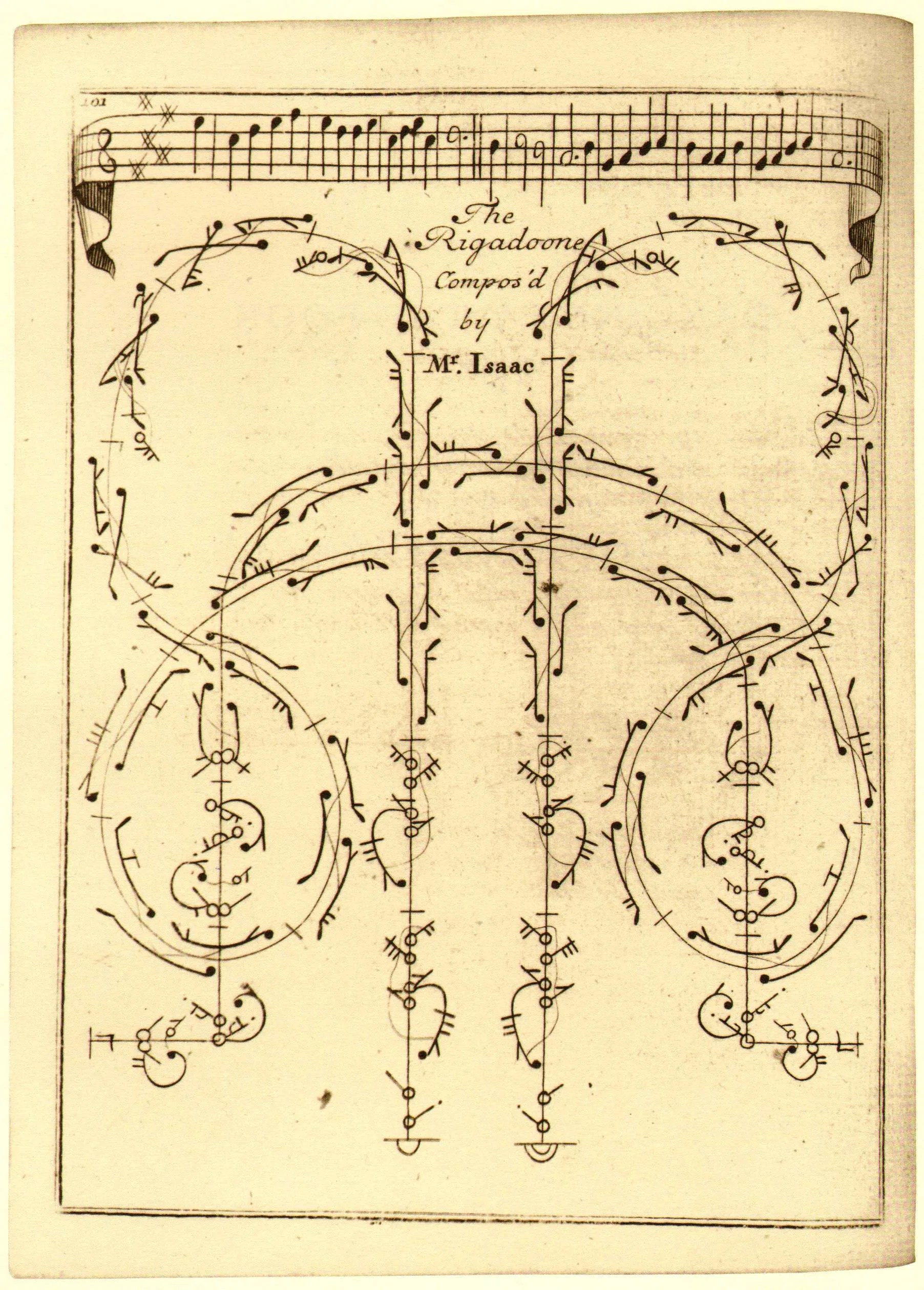
With no moving images available from the 18th century, Alena has had to interpret many of the dances from the instruction books produced at the time.
Illustrations of the step sequence are often a complicated pattern of lines.
Look at this one from 1721 of the notation for the Rigaudon.
I found a demonstration on YouTube here that looks as if it follows something of those movements.
And then the dance was over
The hours flew by in what was an entertaining, interesting and inspiring afternoon. Alena and Frances provided me with lots of thoughts and ideas for future books!
Happy reading, and enjoy the dance!

Wish I’d seen that, Sarah. Sounds fascinating and what great research for an author who writes in the period. I noted that Alena wore Regency rather than Georgian costume but I don’t blame her. Dancing a fast reel in a dress with panniers would have been a pain. Also 18th century dress would be much more difficult and expensive to make than a simple Regency one.
It was fascinating, Joanna, I learned a lot. Although it was primarily about 18th C dance in Scotland, much of it is relevant to England as well, because many of the dances were performed in all the bigger cities of both countries. I have seen pictures of Alena in Georgian costume on the Les Dances Antiques website, but I think the Regency dress was a good choice because we could see the dance steps more easily. Some of the illustrations she used showed how difficult it must have been to dance in those huge 18th C hoops and panniers, especially when you think of the huge hairstyles that became popular later in the century.
I enjoyed this article very much as it gives a glimpse of “entertainment” in the past although some look quite complicated.
Thanks for stopping by, Yve. The dance instruction manuals look extremely complicated! I have tried my hand (or feet!) at Scottish Country Dance, and those are difficult enough – imagine trying to take the lady’s part in a large hooped dress and enormous hairstyle!
What a fascinating blog. I learned historical dance in my early research days. I attended a group for a few weeks and learned the minuet, slow and fast, the allemande (which I can’t remember at all) and a couple of country dances. It was fun and very useful for the writing. I’m not surprised you came away inspired.
Thank you, Liz, glad you enjoyed it. I find Scottish Country Dances difficult enough – lose concentration for a moment and it can cause chaos! 18th C ladies and gentlemen must have had to practice many hours before they could perform all these dances well.
What a wonderful description, Sarah. Huge thanks. I almost felt as if I was there.
As an occasional Scottish dancer myself, I blench at the thought of dancing in a hooped skirt. I think the ladies would have had to content themselves with gliding gracefully, feet unseen, and make all other movements as small as possible, to avoid serious injury to others. All the dancing flourishes and extra twirls (my great fear as a Visiting Occasional, even in today’s dress) would have to have been left to the gentlemen.
Though it is possible to walk, albeit in time with the music, and still deliver an acceptable performance of the dance, as Bridgerton and many, many Jane Austen adaptations have shown. You still have to pay huge attention to the oncoming traffic, no matter what you wear, though.
I quite agree with you, Sophie, dancing in a huge and heavy skirt must have been quite a challenge, even in a slow dance!
Alena did explain that male professional dancers of the time were paid more than females – because more of their legs were on display and the movements could be seen and appreciated!
What a thorough enjoyable blog, Sarah and what a gift to someone writing in that period. I fear there will be no blogs in the future about dancing in the 21st century! Let’s face it, the jive is already historical!
Glad you enjoyed the blog, Liz. Alena has quite a lot of videos online which is so useful. As for 21st C dance, I have no idea how that will evolve over the rest of the century!