
Sophie is plumbing the depths of her archives…

I’ve always been interested in The Romantic Scene, Recently, weeding my bulging box files, I fell over notes on the subject. They were for a discussion that I and the late, great Sara Craven a.k.a. Annie Ashurst led at a conference in Durham in, I think, 2002.
I’ve blogged about this session at Libertà before. But I re-read our scrappy starting script and the notes I scrawled of the subsequent discussion. And I wondered if Libertà readers might be interested in a bit more meat on the bones.
Once More With Feeling
Actually people were still bringing up that class of ours in an online discussion the following year. We found people quoting our own thoughts back at us, which was a bit startling. I had some notes of what our attendees had said. But neither Annie nor I had taken much in the way of notes of our own contributions to the discussion. At the distance of 15 months, we mostly couldn’t remember what either of us had said once we got away from the starting gate.
 Indeed, it was pure chance that we’d prepared a Starting Note at all. We’d just opened a bottle of wine and kicked around some increasingly hysterical ideas, until we realised we might just possibly have a Project.
After that I went to stay with Annie for a weekend and for two days we talked favourite romantic scenes. I remember a long session round the fire, where we took it in turns to leap up and get books off her bookshelf and read favourite bits aloud.
Out of that we produced a short list of precise scenes we thought our discussion buddies might already know. Or, if they didn’t, we could sell it to them with a bit of reading aloud.
What is The Romantic Scene?
 But what we weren’t quite certain was what, exactly, was the romantic scene?
Annie had a clearer Idea than I did. “You know one when you read one,” she said. “It’s a moment that everyone remembers. The scene people talk about with other people who’ve read the book.” She thought a bit. “The place where the book from your Keeper Shelf falls open.”
Yup.
 So there we were, approaching it from the perspective of the reader. Well, we were talking to an audience of writers of romantic fiction. They’d probably be OK with that as a guide to recognition. Now all we had to do was explore how our favourites worked and why they were memorably romantic.
But we still realised that we were going have to explain what, for the purposes of our discussion, we meant by “the romantic scene”.
Of course, with an audience of writers, some of whom might not yet be published, the risk was that they might be looking for rules. “We have to make it clear,” said Annie. “This is a discussion. No rules, no fail safes. And absolutely no no-nos!”
Choosing Our Favourite Great Romantic Scenes
 We narrowed our discussion down to each of us proposing 6, 5 of which had to be from books which there was a decent chance our group would have read at some point. We disallowed our own. (Several Sara Craven romantic scenes had been on my long list.) The aim was to get down to 5 in total, with only one scene per author.
Arguing…
We had a terrific fight over which scene to choose by Mary Stewart. There were at least two from all her romantic suspense novels. I wanted one of her idyllic scenes of happy lovers. But Annie thought they weren’t the best. We eventually decided on the electrifying final encounter between Linda and Raoul in NIne Coaches Waiting. With so much misunderstanding and apparent betrayal between them, how can it not be a disaster?
And then there is a little turn of the kaleidoscope.
 …a lonely figure in the queerly-lit darkness? It came to me suddenly that this was how I would always remember him, somehow standing alone, apart from the others even of his own family. And, I think for the first time, I began to see him as he really was—not any more as a projection of my young romantic longings…. the tiger I thought I preferred… but a quiet, lonely little boy in a house that was “not a house for children… a young man fighting bitterly to save his small inheritance from ruin… wild, perhaps, hard, perhaps, plunging off the beaten track more than once… but always alone. Wrapped up in my loneliness and danger I hadn’t even seen that his need was the same as my own. He and I had hoed the same row and he for a more bitter harvest.
And at last she says the right thing. Edge of the seat stuff. Raises the hair on the back of my neck, even after all these years.
Interestingly author and protagonist may have came on the identical journey. According to a lovely blog by Mary Queen of Plots, which I have only just discovered, Raoul de Valmy started life as double dyed villain. So glad she dug deeper!
Agreement
 But on Jane Austen, Annie and I were unanimous. It had to be Persuasion, the scene where Anne Elliot talks to Captain Harvill about men’s and women’s affections, while Captain Wentworth writes a letter in another part of the room. “All the privilege I claim for my own sex (it is not a very enviable one: you need not covet it), is that of loving longest, when existence or when hope is gone!”
A big part of the impact of that is in the space between the words. And the reader never forgets, for an instant, that Captain Wentworth can hear her every word!
Annie and I also agreed on that old warhorse, The Scarlet Pimpernel. Specifically we chose the scene where Sir Percy resists the wife he still loves but not longer trusts when they meet in the moonlight on the steps of their country house. The only trouble was the scene was 7 pages long when we downloaded it from Project Gutenberg! We made copies, and passed it round with a few comments. “Bit over-heated,” said one of the faster readers. Very wisely.
Romantic Scenes in Georgette Heyer?
 By contrast, we had real difficulty indentifying one at all from Georgette Heyer. SIr Tristram’s proposal to Miss Thane from The Talisman Ring won in the end, largely because it carries so much real feeling between the words; and is also deliciously funny.
But the romantic element in Heyer is woven so tightly through plot and character, that the memorable moment is often no more than a sentence, or even a word, within a complicated scene.
Consider the end of the fight between husband and wife in April Lady; or poor Lady Hester in Sprig Muslin, refusing a proposal from the love of her life, because she knows that he doesn’t love her. (Spoiler alert: yet.)
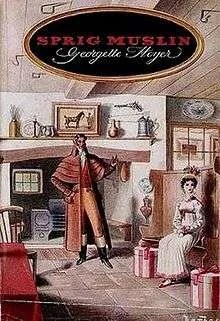 “I can offer you a position of the first consequence. You would be at no one’s beck and call, you would be your own mistress—with a husband who, I promise you, would not make unreasonable demands of you. You may be sure that I should always attend to your wishes, and hold you in respect as well as affection. Would that not mean a happier life than the one you now lead?”
Her face was very white; she pulled her hand away, saying in a stifled voice: “No—anguish!”
This seemed so strange a thing for her to have said that he thought he could not have heard her aright. “I beg your pardon?” he said blankly.
Yes, I was a strong advocate for that one. But Annie said there was too much else going on. And she was right.
Conclusions
 So that was our final list. Well, except for the Idyll (mine was by Eva Ibbotson; I can’t actually remember which one Annie opted for, alas) and the Wild Card, which was my own candidate. Annie, who hadn’t read the book or author (The Zero Trap by Paula Gosling) before, fell on it with cries of delight. I may blog about that another time.
After choosing them, of course, we came full circle. What did they have in common?

The only thing really, is that they catch you by the throat. That is, if they work for you. Not every Big Romantic Scene works for everyone.
They make you feel. But they also make you think, not just in some semi-detached sympathy for the protagonist but empathetically. They may well make you cry and laugh at the same time.
From the writer’s point of view, they have a rhythm of their own that is different from the surrounding narrative. And, whatever the rest of the story’s general variation of psychic distance, you’re well and truly up close and personal with the protagonist(s) in a Great Romantic Scene.
 But just about everything else in these examples differs widely — where they come in the story, what they convey, even the emotions that hit you. Some are contemplative. Some are all action. (And, interestingly, not a single one, even of the longest list, was a sex scene. That surprised both Annie and me.)
Some occur at points of discovery or critical change in the plot. Some show people achieving acceptance and peace. Some are nearly all dialogue. Some are conducted in near silence.
Discussion Results
 In the end I think that long-ago discussion concluded that the big romantic scenes are very concentrated. Mostly that tends to mean that less is more.
And that in turn makes the choice of pace and vocabulary very important.
By the time you’ve got to one of these Big Moments, you’re almost writing a poem, I think. The best thing to do is keeping it short and truthful, and leave space between the words for the reader chemistry to react.
 My notes say we mostly thought that probably meant writing fast for energy and impetus. And when it came to editing, cut, cut, cut. Then re-read slowly — because that’s how your reader will want to savour it.
And one word of warning. Big Romantic Scenes grow out of what you’ve already written. You can’t write one from cold. (Annie and I both tried. They were truly horrible.)
But when one comes, recognise it. Embrace it and take your time. They’re a joy for everyone.
 Sophie
Ah, I remember that session with so much pleasure. Partly for the ‘Less is More’ insight, partly for the ‘Slow Burn is Better’ moment (though I’m not sure we called it that, back then), but mostly for the enthusiasm and blazing, infectious delight you and Annie had for the books and the scenes.
A utilitarian upper classroom in Durham, sunshine lighting you both up through the blinds, and the distillation of what makes a romantic scene brought to us through the best discussion ever.
Oh Jan, how lovely. That’s how I remember it too. Everyone just buzzing with enthusiasm for their own special favourites. Thank you!
I so wish I’d be there, Sophie. My unforgettable moment is when, in Venetia, Damerel takes the basket of kittens from her and demonstrates how a rake would seduce a woman. The kiss is enchanting but we see Damerel recognize that he has fallen in love and because of that chooses to distance himself. A bit of a heartstop moment. But it’s so long since I read Nine Coaches Waiting and, having just bought all of Mary Stewart’s books to re-read, I know where I will be starting.
Oh, that Venetia scene is lovely, Liz. I don’t think Annie and I discussed that one as a possibility. I wonder why not? It’s brilliant, too, because you get the feeling of both people’s reactions but they don’t get each other’s. Well, not entirely, anyway.
In fact from the moment Dameral arrives the whole book is pretty much one great romantic scene. I love the one where she arrives at his house to take care of her brother. He (gleefully) expects her to be distant and on her dignity (after his disgraceful behaviour when they first met) and she bundles out of the coach full of genuine gratitude, relief and friendliness. It completely wrong foots him. And Venetia doesn’t begin to realise it. Gorgeous stuff!
Brilliant, Sophie, thank you for that. I agree with you about Venetia, one big romantic scene! My heart always breaks for Venetia when she is in London, and so very lonely without Damerel.
Also, having just finished my latest edits and re-read the whole manuscript, I know I was influenced by that proposal in Sprig Muslin, even though I haven’t read it for years. Not that my scene can in any way compare with Heyer’s, but the sentiment is the same.
Lots of discussion still to have on this topic, I am sure!
Oh yes, Sarah, Venetia is one of books where she really does skirt the edge of tragedy, isn’t it?
I look forward to reading your book with a dash of Sprig Muslin flavouring.
Oh, that scene in April Lady! For my money, the most romantic line in the entire canon is the anguished cry from Giles: “No! Come back! I didn’t mean it, Nell! I didn’t mean it!” The last one italicised which just shows his inner torment. I LOVE that scene even though I find it heartbreaking.
You’ve got me thinking now of where in my Lady Fan canon are the Big Romantic Scenes – or moments. I can think of a couple that wrench my heart for Francis and Ottilia. I can only hope they have the same effect on readers.